
外观
02.泛型编程简介、智能指针示例、异常类构建、顶层父类的创建
八、泛型编程简介
1、数据结构课程的特点
- 专注于数据元素之间的关系
- 专注于特定结构之上的算法
- 数据结构课程并不已关注数据元素的具体类型!
2、问题
如何为数据结构的学习选择合适的语言?
3、经验分享
支持泛型编程的语言最适合数据结构课程的学习?
4、泛型编程的概念
不考虑具体数据类型的编程方式
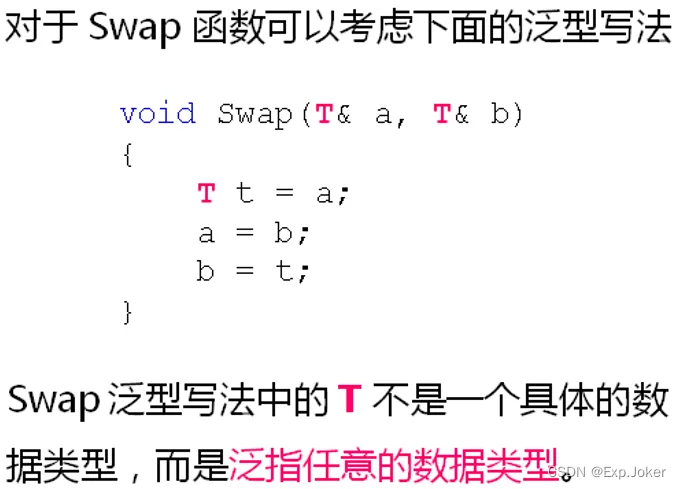
5、C++中的函数模板
一种特殊的函数可用不同类型进行调用
看起来和普通函数很相似,区别是类型可被参数化
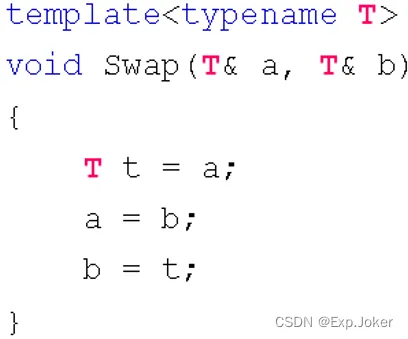
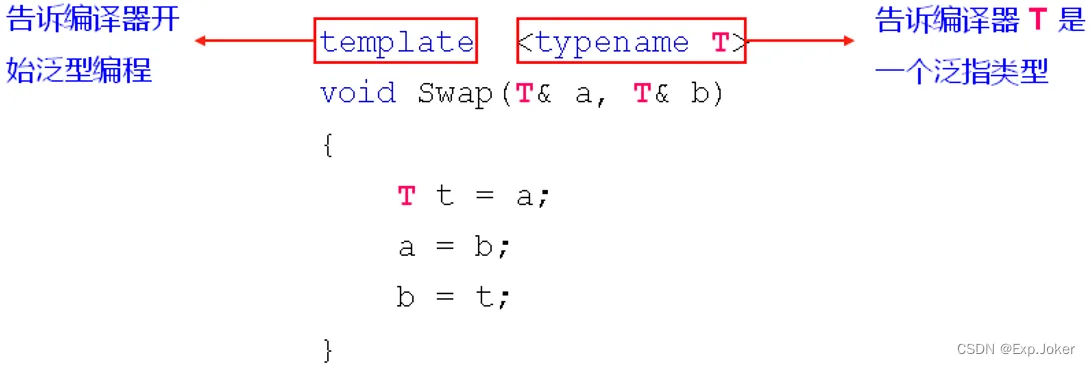
6、函数模板的语法规则
template关键字用于声明开始进行泛型编程
typename关键字用于声明泛指类型
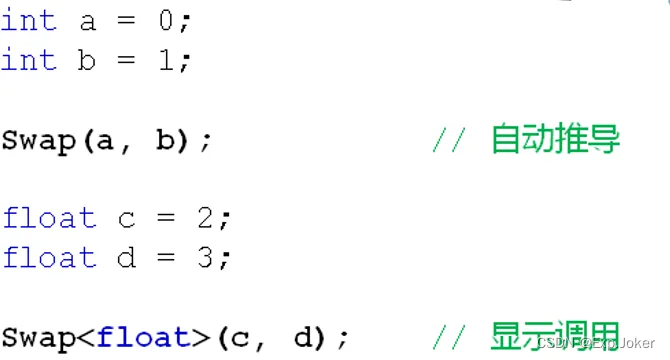
7、函数模板的使用
自动类型推导调用
具体类型显示调用
8、编程实验:函数模板初探
与下一个实验在一起。
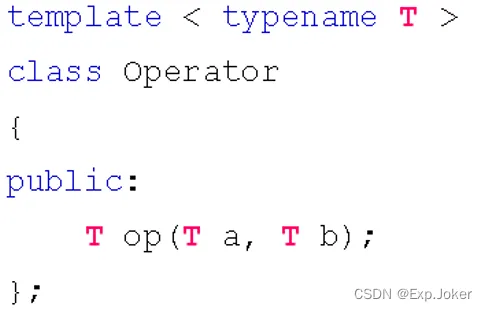
9、C++中的类模板
以相同的方式处理不同的类型
在类声明前使用template进行标识
< typename T>用于说明类中使用的泛指类型 T
10、类模板的应用
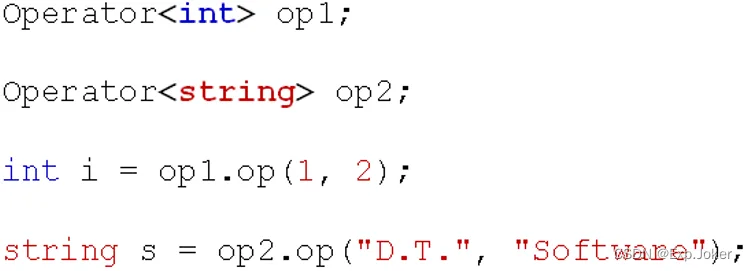
只能显示指定具体类型,无法自动推导
使用具体类型<Type>定义对象
11、编程实验:类模板初探
#include <iostream>

using namespace std;

template <typename T>
void Swap(T& a, T& b)
{
    T t = a;
    a = b;
    b = t;
}

template <typename T>
class Op
{
public:
    T process(T v)
    {
        return v * v;
    }
};

int main()
{
    int a = 2;
    int b = 1;

    Swap(a, b);

    cout << "a = " << a << " " << "b = " << b << endl;

    double c = 0.01;
    double d = 0.02;

    Swap<double>(d, c);

    cout << "c = " << c << " " << "d = " << d << endl;

    Op<int> opInt;
    Op<double> opDouble;

    cout << "5 * 5 = " << opInt.process(5) << endl;
    cout << "0.3 * 0.3 = " << opDouble.process(0.3) << endl;

    return 0;
}
12、小结
模板是泛型编程理论在C++中的实现
函数模板支持参数的自动推导和显示指定
类模板在使用时只能显示指定类型
类模板非常适用于编写数据结构相关的代码
九、智能指针示例
1、内存泄漏(臭名昭著的Bug )
- 动态申请堆空间,用完后不归还
- C++语言中没有垃圾回收的机制(c#、java、Python有)
- 指针无法控制所指堆空间的生命周期
2、当代C++软件平台中的智能指针
- 指针生命周期结束时主动释放堆空间
- 一片堆空间最多只能由一个指针标识
- 杜绝指针运算和指针比较
3、智能指针的设计方案
通过类模板描述指针的行为
能够定义不同类型的指针对象
重载指针特征操作符(->和*)
利用对象模拟原生指针的行为
4、编程实验:智能指针
SmartPointer.h
#ifndef SMARTPOINTER_H_
#define SMARTPOINTER_H_
/***
 *                              Include Files                                  *
 ***/
#include "Pointer.h"
/***
 *                             Type Definition                                 *
 ***/
namespace DTLib
{

template <typename T>                                               // 泛型编程 - 类模板
class SmartPointer : public Pointer<T>                              // 基于普通指针类
{
public:
    SmartPointer(T* p = NULL) : Pointer<T>(p)                       // 构造函数 - 调用父类构造函数 - 默认指针为NULL
    {

    }

    SmartPointer(const SmartPointer<T>& obj)                        // 拷贝构造函数
    {
        this->m_pointer = obj.m_pointer;                            // 当前对象的堆空间 指向 引入的堆空间

        const_cast<SmartPointer<T>&>(obj).m_pointer = NULL;         // 将原来的堆空间指针置NULL  const_cast 去除对象的const属性
    }

    SmartPointer<T>& operator= (const SmartPointer<T>& obj)         // 重载赋值操作符
    {
        if( this != &obj )                                          // 判断是否为 自赋值
        {
            T* p = this->m_pointer;                                 //为了防止类异常抛出,所以最后释放堆空间

            this->m_pointer = obj.m_pointer;                        // 当前对象的堆空间 指向 引入的堆空间

            const_cast<SmartPointer<T>&>(obj).m_pointer = NULL;     // 将原来的堆空间指针置NULL  const_cast 去除对象的const属性

            delete p;                                               // 释放当前指针指向的堆空间
        }

        return *this;                                               // 返回自己(支持连续赋值)
    }

    ~SmartPointer()                                                 // 析构函数 - 释放智能指针对应的堆空间
    {
        delete this->m_pointer;
    }
};

}

#endif // SMARTPOINTER_H_
Pointer.h
#ifndef POINTER_H_
#define POINTER_H_
/***
 *                              Include Files                                  *
 ***/
#include "Object.h"
/***
 *                             Type Definition                                 *
 ***/
namespace DTLib
{

template < typename T >         // 泛型编程 - 类模板 T
class Pointer : public Object
{
protected:                      // protected 可以被子类直接访问; 不能被外界直接访问
    T* m_pointer;
public:
    Pointer(T* p = NULL)        // 构造函数 - 默认指针为NULL
    {
        m_pointer = p;
    }

    T* operator-> ()            // 重载 ->  返回指针地址
    {
        return m_pointer;
    }

    T& operator* ()             // 重载 *  返回值
    {
        return *m_pointer;
    }

    const T* operator-> () const // 重载 ->  返回指针地址            const对象只能调用const的成员函数
    {
        return m_pointer;
    }

    const T& operator* () const // 重载 *    返回值                 const对象只能调用const的成员函数
    {
        return *m_pointer;
    }

    bool isNull() const         // 判断当前的智能指针是否为空指针     const对象只能调用const的成员函数
    {
        return (m_pointer == NULL);
    }

    T* get() const              // 获取智能指针的值                  const对象只能调用const的成员函数
    {
        return m_pointer;
    }

    virtual ~Pointer() = 0;     // 析构函数  纯虚函数(抽象类)
};

template < typename T >
Pointer<T>::~Pointer()
{

}

}

#endif // POINTER_H_
5、智能指针分析
智能指针的使用军规:只能用来指向堆空间中的单个对象或者变量
6、小结
指针特征操作符( ->和*)可以被重载
重载指针特征符能够使用对象代替指针
智能指针只能用于指向堆空间中的内存
智能指针的意义在于最大程度的避免内存问题
十、C++异常简介
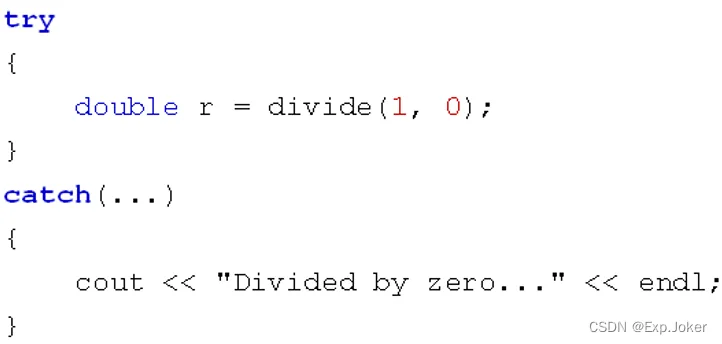
1、C++内置了异常处理的语法元素try ... catch …
try语句处理正常代码逻辑
catch语句处理异常情况
try语句中的异常由对应的catch语句处理
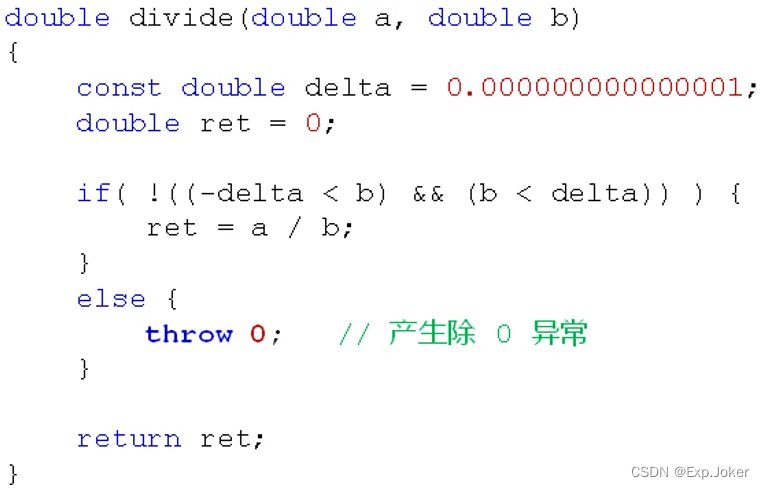
2、C++通过throw语句抛出异常信息
3、C++异常处理分析
throw抛出的异常必须被catch处理
当前函数能够处理异常,程序继续往下执行
当前函数无法处理异常,则函数停止执行,并返回
未被处理的异常会顺着函数调用栈向上传播,直到被处理为止,否则程序将停止执行。
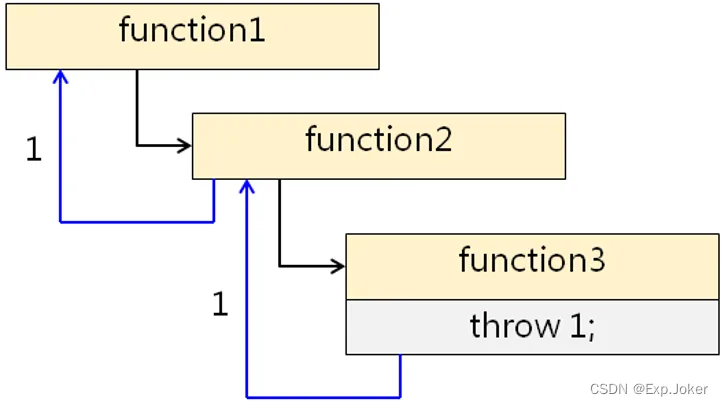
4、编程实验:C++异常处理初探
5、C++异常简介
- 同一个try语句可以跟上多个catch语句
- catch语句可以定义具体处理的异常类型
- 不同类型的异常由不同的catch语句负责处理
- try语句中可以抛出任何类型的异常
- catch(.….)用于处理所有类型的异常
- 任何异常都只能被捕获( catch )一次
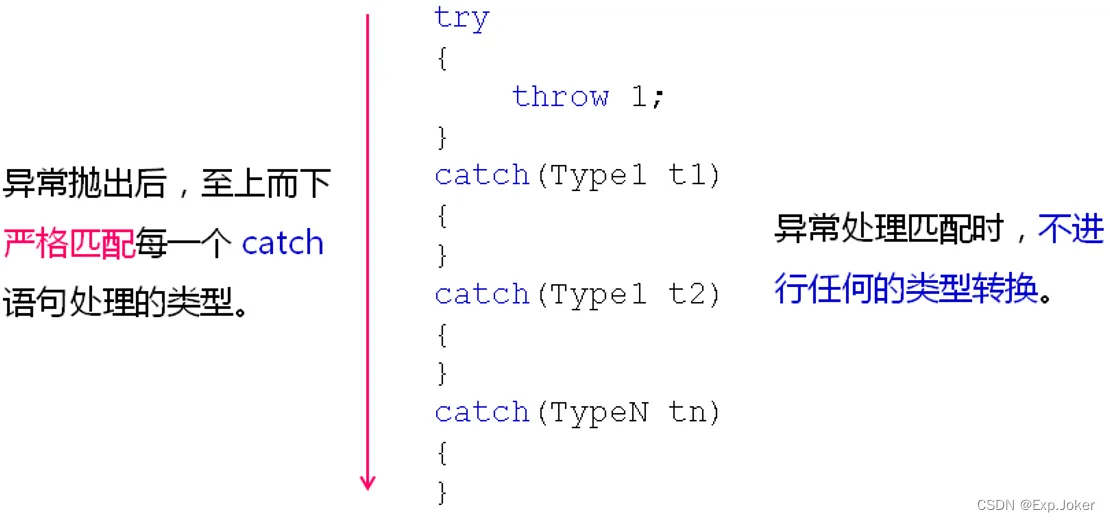
6、异常处理的匹配规则
7、编程实验:异常类型匹配
#include <iostream>

using namespace std;

double divide(double a, double b)
{
    const double delta = 0.000000000000001;
    double ret = 0;

    if( !((-delta < b) && (b < delta)) ) {
        ret = a / b;
    }
    else {
        throw 0;   // 产生除 0 异常
    }

    return ret;
}

void Demo1()
{
    try
    {
        throw 'c';
    }
    catch(int i)
    {
        cout << "catch(int i)" << endl;
    }
    catch(double d)
    {
        cout << "catch(double d)" << endl;
    }
    catch(char c)
    {
        cout << "catch(char c)" << endl;
    }
}

void Demo2()
{
    throw 0.0001; // "D.T.Software";   // const char*
}

int main()
{
    cout << "main() begin" << endl;

    try
    {
        double c = divide(1, 1);

        cout << "c = " << c << endl;
    }
    catch(...)
    {
        cout << "Divided by zero..."  << endl;
    }

    Demo1();

    try
    {
        Demo2();
    }
    catch(char* c)
    {
        cout << "catch(char* c)" << endl;
    }
    catch(const char* cc)
    {
        cout << "catch(char* cc)" << endl;
    }
    catch(...)
    {
        cout << "catch(...)" << endl;
    }

    cout << "main() end" << endl;

    return 0;
}
8、小结
- C++中直接支持异常处理的概念
- try... catch...是C++中异常处理的专用语句
- try语句处理正常代码逻辑,catch语句处理异常情况
- 同一个try语句可以跟上多个catch语句
- 异常处理必须严格匹配,不进行任何的类型转换
十一、异常类构建
1、异常类构建
- 异常的类型可以是自定义类类型
- 对于类类型异常的匹配依旧是至上而下严格匹配
- 赋值兼容性原则在异常匹配中依然适用
- 一般而言
- 匹配子类异常的catch放在上部
- 匹配父类异常的catch放在下部
2、现代C++库必然包含充要的异常类族
异常类是数据结构类所依赖的“基础设施”!
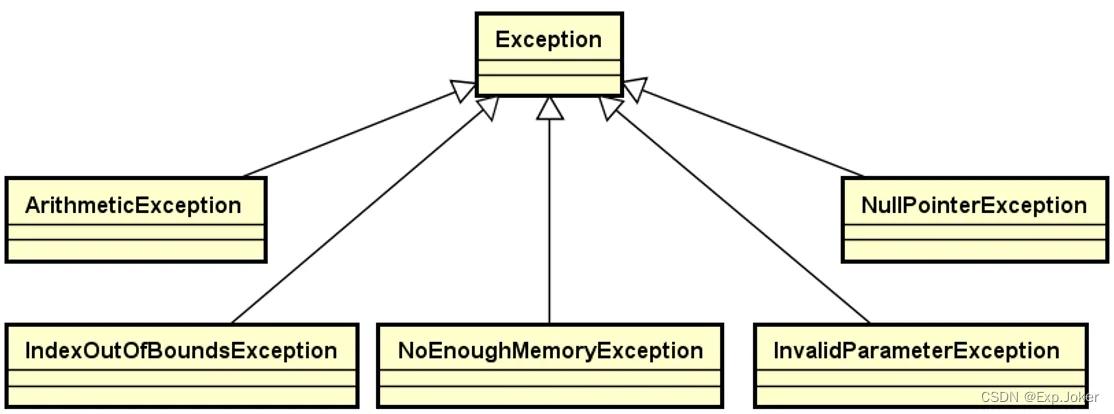
3、异常类功能定义
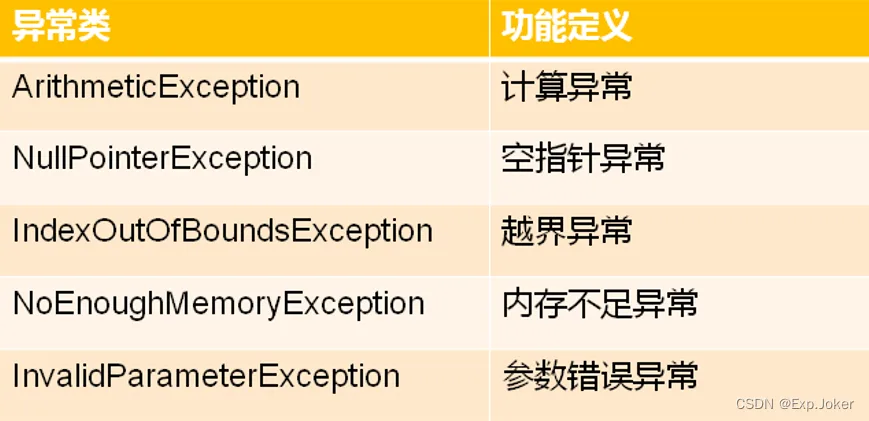
4、异常类中的接口定义
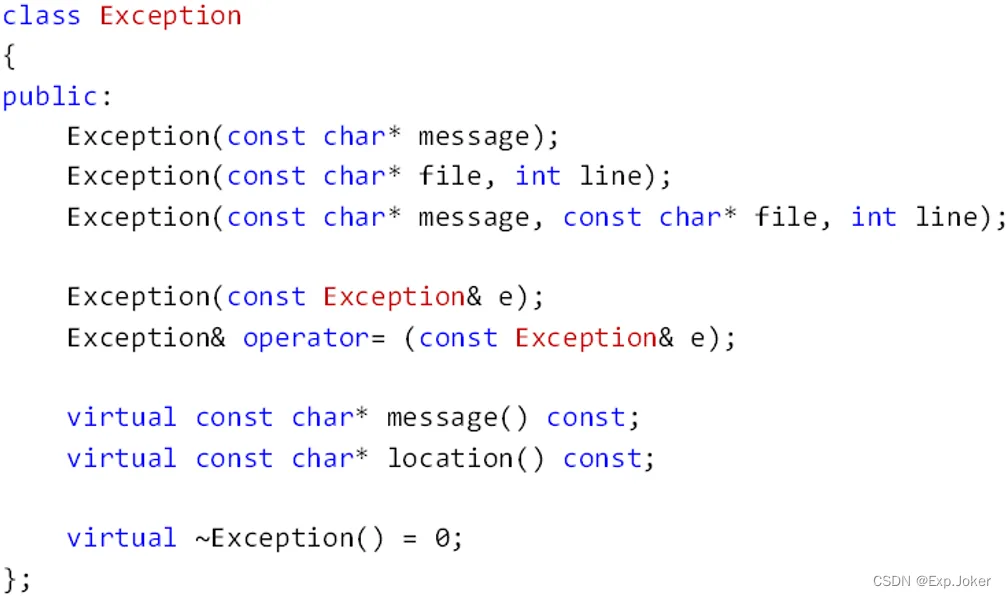
5、编程实验:创建异常类族
Exception.cpp
/***
 *                              Include _Files                                  *
 ***/
#include "Exception.h"
#include <cstring>
#include <cstdlib>
#include <cstdio>

using namespace std;
/***
 *                             Type Definition                                 *
 ***/
namespace DTLib
{
/**
* Function:        Exception::init()
* Description:     辅助初始化函数
* Table Accessed:
* Table Updated:
* Input:            _message            异常的说明信息
*                   _file               发生异常的文件名
*                   _line               发生异常的行号
* Output:           m_message           异常的说明信息      (类中成员)
*                   m_location          异常的文件名和行号  (类中成员)
* Return:
* Others:           用于被重载函数调用
* Modify   Date     Version    Author      Modification
* ------------------------------------------------------------
*       2022/03/09    1.0                            Create
**/
void Exception::init(const char* _message, const char* _file, int _line)
{
    #define STR_CAT_LINE        16      // 行号字符串拼接长度
    #define STR_CAT_SYMBOL      2       // 文件名和行号的隔离符号(:); 字符串结束符\0

    // 获取 异常的说明信息
    m_message = (_message ? strdup(_message) : NULL);   //判断_message是否为空(strdup默认入参不为空)  strdup将字符串复制到堆空间,返回指针地址

    // 获取 发生异常的文件名和行号
    if( _file != NULL )
    {
        // 将行号转为字符串类型
        char acLineStrcat[STR_CAT_LINE] = {0};
        // itoa(_line, acLineStrcat, 10);
        snprintf(acLineStrcat, sizeof(acLineStrcat), "%d", _line);

        // 申请堆空间,进行拼接文件名和行号
        m_location = static_cast<char*>(malloc(strlen(_file) + strlen(acLineStrcat) + STR_CAT_SYMBOL));
        if( m_location != NULL )
        {
            m_location = strcpy(m_location, _file);                 // 拷贝文件名
            m_location = strcat(m_location, ":");                   // 拼接  :
            m_location = strcat(m_location, acLineStrcat);          // 拼接 行号
        }
    }
    else
    {
        m_location = NULL;
    }
}

/**
* Function:        Exception::Exception()
* Description:      重载函数
* Input:            _message            异常的说明信息
*                   _file               发生异常的文件名
*                   _line               发生异常的行号
* Others:           用于被重载函数调用
* Modify   Date     Version    Author      Modification
* ------------------------------------------------------------
*       2022/03/09    1.0                            Create
**/
Exception::Exception(const char* _message)
{
    init(_message, NULL, 0);
}

Exception::Exception(const char* _file, int _line)
{
    init(NULL, _file, _line);
}

Exception::Exception(const char* _message, const char* _file, int _line)
{
    init(_message, _file, _line);
}

/**
* Function:        Exception::Exception()
* Description:      拷贝函数重载(深拷贝)
* Input:            Exception           传入待拷贝的Exception类
* Output:           Exception           创建的Exception类   (类中成员)
* Return:
* Others:           深拷贝 - 成员指向了动态内存空间
* Modify   Date     Version    Author      Modification
* ------------------------------------------------------------
*       2022/03/09    1.0                            Create
**/
Exception::Exception(const Exception& _eWaitCopy)
{
    m_message = strdup(_eWaitCopy.m_message);
    m_location = strdup(_eWaitCopy.m_location);
}

/**
* Function:        Exception::Exception()
* Description:      赋值运算符重载
* Input:            Exception           传入待拷贝的Exception类
* Output:           Exception           创建的Exception类   (类中成员)
* Return:           Exception           当前类的指针
* Others:           返回当前类的指针,代表允许连续赋值
* Modify   Date     Version    Author      Modification
* ------------------------------------------------------------
*       2022/03/09    1.0                            Create
**/
Exception& Exception::operator= (const Exception& _eWaitCopy)
{
    if( this != &_eWaitCopy )
    {
        free(m_message);
        free(m_location);

        m_message = strdup(_eWaitCopy.m_message);
        m_location = strdup(_eWaitCopy.m_location);
    }

    return *this;
}

/**
* Function:        Exception::message()
* Description:      返回异常的说明信息的指针
* Input:
* Output:
* Return:           char* m_message     返回异常的说明信息的指针
* Others:
* Modify   Date     Version    Author      Modification
* ------------------------------------------------------------
*       2022/03/09    1.0                            Create
**/
const char* Exception::message() const
{
    return m_message;
}

/**
* Function:        Exception::location()
* Description:      返回异常文件名和行号的指针
* Input:
* Output:
* Return:           char* m_location    返回异常文件名和行号的指针
* Others:
* Modify   Date     Version    Author      Modification
* ------------------------------------------------------------
*       2022/03/09    1.0                            Create
**/
const char* Exception::location() const
{
    return m_location;
}

/**
* Function:        Exception::~Exception()
* Description:      析构函数
* Input:
* Output:
* Return:
* Others:           纯虚函数(抽象类) - 纯虚函数的实现由子类完成,这里是个例外,但凡定义析构函数就必须要提供实现,不管是不是纯虚的.
* Modify   Date     Version    Author      Modification
* ------------------------------------------------------------
*       2022/03/09    1.0                            Create
**/
Exception::~Exception()
{
    free(m_message);
    free(m_location);
}

}
Exception.h
#ifndef EXCEPTION_H_
#define EXCEPTION_H_
/***
 *                              Include Files                                  *
 ***/
#include "Object.h"

/***
 *                             Type Definition                                 *
 ***/
namespace DTLib
{
#define THROW_EXCEPTION(e, m) (throw e(m, __FILE__, __LINE__))      // 异常类型;说明信息

/** 异常父类 **/
class Exception : public Object
{
protected:
    char* m_message;                                                // 当前异常的说明信息
    char* m_location;                                               // 当前异常的位置信息

    void init(const char* _message, const char* _file, int _line);     // 辅助初始化 - 定义了多个重载函数
public:
    Exception(const char* message);                                 // 构造函数 - 重载函数
    Exception(const char* file, int line);                          // 构造函数 - 重载函数
    Exception(const char* message, const char* file, int line);     // 构造函数 - 重载函数

    Exception(const Exception& _eWaitCopy);                                  // 拷贝构造函数
    Exception& operator= (const Exception& _eWaitCopy);                      // 赋值构造函数

    virtual const char* message() const;                            // 异常对象的说明信息
    virtual const char* location() const;                           // 异常对象的位置信息

    virtual ~Exception() = 0;                                       // 纯虚函数(抽象类) - 析构函数
};

/** 计算异常子类 **/
class ArithmeticException : public Exception
{
public:
    // 显式调用父类构造函数
    ArithmeticException() : Exception(0) { }
    ArithmeticException(const char* message) : Exception(message) { }
    ArithmeticException(const char* file, int line) : Exception(file, line) { }
    ArithmeticException(const char* message, const char* file, int line) : Exception(message, file, line) { }

    // 显式调用父类拷贝构造函数
    ArithmeticException(const ArithmeticException& eWaitCopy) : Exception(eWaitCopy) { }
    // 调用父类赋值重载函数
    ArithmeticException& operator= (const ArithmeticException& eWaitCopy)
    {
        Exception::operator=(eWaitCopy);

        return *this;
    }
};

/** 空指针异常子类 **/
class NullPointerException : public Exception
{
public:
    // 显式调用父类构造函数
    NullPointerException() : Exception(0) { }
    NullPointerException(const char* message) : Exception(message) { }
    NullPointerException(const char* file, int line) : Exception(file, line) { }
    NullPointerException(const char* message, const char* file, int line) : Exception(message, file, line) { }

    // 显式调用父类拷贝构造函数
    NullPointerException(const NullPointerException& eWaitCopy) : Exception(eWaitCopy) { }
    // 调用父类赋值重载函数
    NullPointerException& operator= (const NullPointerException& eWaitCopy)
    {
        Exception::operator=(eWaitCopy);

        return *this;
    }
};

/** 越界异常子类 **/
class IndexOutOfBoundsException : public Exception
{
public:
    // 显式调用父类构造函数
    IndexOutOfBoundsException() : Exception(0) { }
    IndexOutOfBoundsException(const char* message) : Exception(message) { }
    IndexOutOfBoundsException(const char* file, int line) : Exception(file, line) { }
    IndexOutOfBoundsException(const char* message, const char* file, int line) : Exception(message, file, line) { }

    // 显式调用父类拷贝构造函数
    IndexOutOfBoundsException(const IndexOutOfBoundsException& eWaitCopy) : Exception(eWaitCopy) { }
    // 调用父类赋值重载函数
    IndexOutOfBoundsException& operator= (const IndexOutOfBoundsException& eWaitCopy)
    {
        Exception::operator=(eWaitCopy);

        return *this;
    }
};

/** 内存不足异常子类 **/
class NoEnoughMemoryException : public Exception
{
public:
    // 显式调用父类构造函数
    NoEnoughMemoryException() : Exception(0) { }
    NoEnoughMemoryException(const char* message) : Exception(message) { }
    NoEnoughMemoryException(const char* file, int line) : Exception(file, line) { }
    NoEnoughMemoryException(const char* message, const char* file, int line) : Exception(message, file, line) { }

    // 显式调用父类拷贝构造函数
    NoEnoughMemoryException(const NoEnoughMemoryException& eWaitCopy) : Exception(eWaitCopy) { }
    // 调用父类赋值重载函数
    NoEnoughMemoryException& operator= (const NoEnoughMemoryException& eWaitCopy)
    {
        Exception::operator=(eWaitCopy);

        return *this;
    }
};

/** 参数错误异常子类 **/
class InvalidParameterException : public Exception
{
public:
    // 显式调用父类构造函数
    InvalidParameterException() : Exception(0) { }
    InvalidParameterException(const char* message) : Exception(message) { }
    InvalidParameterException(const char* file, int line) : Exception(file, line) { }
    InvalidParameterException(const char* message, const char* file, int line) : Exception(message, file, line) { }

    // 显式调用父类拷贝构造函数
    InvalidParameterException(const InvalidParameterException& eWaitCopy) : Exception(eWaitCopy) { }
    // 调用父类赋值重载函数
    InvalidParameterException& operator= (const InvalidParameterException& eWaitCopy)
    {
        Exception::operator=(eWaitCopy);

        return *this;
    }
};

/** 成员函数调用异常子类 **/
class InvalidOperationException : public Exception
{
public:
    // 显式调用父类构造函数
    InvalidOperationException() : Exception(0) { }
    InvalidOperationException(const char* message) : Exception(message) { }
    InvalidOperationException(const char* file, int line) : Exception(file, line) { }
    InvalidOperationException(const char* message, const char* file, int line) : Exception(message, file, line) { }

    // 显式调用父类拷贝构造函数
    InvalidOperationException(const InvalidOperationException& eWaitCopy) : Exception(eWaitCopy) { }
    // 调用父类赋值重载函数
    InvalidOperationException& operator= (const InvalidOperationException& eWaitCopy)
    {
        Exception::operator=(eWaitCopy);

        return *this;
    }
};

}

#endif // EXCEPTION_H_
6、设计原则
在可复用代码库设计时,尽量使用面向对象技术进行架构,尽量使用异常处理机制分离正常逻辑和异常逻辑。
7、小结
现代C++库必然包含充要的异常类族
所有库中的数据结构类都依赖于异常机制
异常机制能够分离库中代码的正常逻辑和异常逻辑

十二、顶层父类的创建
1、当代软件架构实践中的经验
- 尽量使用单重继承的方式进行系统设计
- 尽量保持系统中只存在单一的继承树
- 尽量使用组合关系代替继承关系
2、不幸的事实
- C++语言的灵活性使得代码中可以存在多个继承树
- C++编译器的差异使得同样的代码可能表现不同的行为
new操作如果失败会发生什么?
3、创建DTLib::object类的意义
- 遵循经典设计准则,所有数据结构都继承自Object类
- 定义动态内存申请的行为,提高代码的移植性,避免不同编译器的影响
4、顶层父类的接口定义
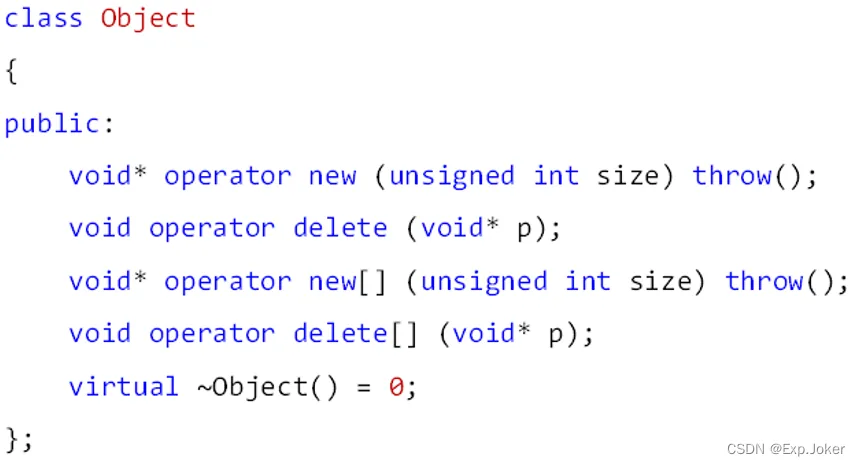
5、编程实验:顶层父类的创建
Object.h
#ifndef OBJECT_H_
#define OBJECT_H_
/***
 *                              Include _Files                                  *
 ***/
#include <cstdlib>
/***
 *                             Type Definition                                 *
 ***/
namespace DTLib
{

class Object
{
public:
    void* operator new (size_t size) throw();       // 重载 new
    void operator delete (void* p);                 // 重载 delete
    void* operator new[] (size_t size) throw();     // 重载 new[]
    void operator delete[] (void* p);               // 重载 delete[]
    bool operator == (const Object& obj);           // 重载 ==          自定义类可能会出现比较操作符,此处为默认写法 - 判断地址是否相同
    bool operator != (const Object& obj);           // 重载 !=          自定义类可能会出现比较操作符,此处为默认写法 - 判断地址是否相同
    virtual ~Object() = 0;                          // 析构函数(纯虚函数 抽象类)
};

}

#endif // OBJECT_H_
Object.cpp
/***
 *                              Include _Files                                  *
 ***/
#include "Object.h"
#include <cstdlib>
/***
 *                             Type Definition                                 *
 ***/
using namespace std;

namespace DTLib
{

/**
* Function:        Object::operator new()
* Description:     重载 new
* Table Accessed:
* Table Updated:
* Input:            size                字节大小
* Output:           void*               指针地址
* Return:
* Others:           throw() 这个重载函数不会抛出任何异常
* Modify   Date     Version    Author      Modification
* ------------------------------------------------------------
*       2022/03/09    1.0                            Create
**/
void* Object::operator new (size_t size) throw()
{
    return malloc(size);
}

/**
* Function:        Object::operator delete()
* Description:     重载 delete
* Table Accessed:
* Table Updated:
* Input:            void*               指针地址
* Output:
* Return:
* Others:
* Modify   Date     Version    Author      Modification
* ------------------------------------------------------------
*       2022/03/09    1.0                            Create
**/
void Object::operator delete (void* p)
{
    free(p);
}

/**
* Function:        Object::operator new[]()
* Description:     重载 new* Table Accessed:
* Table Updated:
* Input:            size                字节大小
* Output:           void*               指针地址
* Return:
* Others:           throw() 这个重载函数不会抛出任何异常
* Modify   Date     Version    Author      Modification
* ------------------------------------------------------------
*       2022/03/09    1.0                            Create
**/
void* Object::operator new[] (size_t size) throw()
{
    return malloc(size);
}

/**
* Function:        Object::operator delete[]()
* Description:     重载 delete* Table Accessed:
* Table Updated:
* Input:            void*               指针地址
* Output:
* Return:
* Others:
* Modify   Date     Version    Author      Modification
* ------------------------------------------------------------
*       2022/03/09    1.0                            Create
**/
void Object::operator delete[] (void* p)
{
    free(p);
}

/**
* Function:        Object::operator ==()
* Description:     ==重载函数
* Table Accessed:
* Table Updated:
* Input:
* Output:
* Return:
* Others:
* Modify   Date     Version    Author      Modification
* ------------------------------------------------------------
*       2022/03/09    1.0                            Create
**/
bool Object::operator == (const Object& obj)
{
    return (this == &obj);
}

/**
* Function:        Object::operator !=()
* Description:     !=重载函数
* Table Accessed:
* Table Updated:
* Input:
* Output:
* Return:
* Others:
* Modify   Date     Version    Author      Modification
* ------------------------------------------------------------
*       2022/03/09    1.0                            Create
**/
bool Object::operator != (const Object& obj)
{
    return (this != &obj);
}

/**
* Function:        Object::~Object()
* Description:     析构函数
* Table Accessed:
* Table Updated:
* Input:
* Output:
* Return:
* Others:
* Modify   Date     Version    Author      Modification
* ------------------------------------------------------------
*       2022/03/09    1.0                            Create
**/
Object::~Object()
{

}

}
6、小结
- Object类是DTLib中数据结构类的顶层父类
- Object类用于统一动态内存申请的行为
- 在堆中创建Object子类的对象,失败时返回NULL值
- Object类为纯虚父类,所有子类都能进行动态类型识别
十三、类族结构的进化
1、遵循经典设计准则
DTLib 中的所有类位于单一的继承树
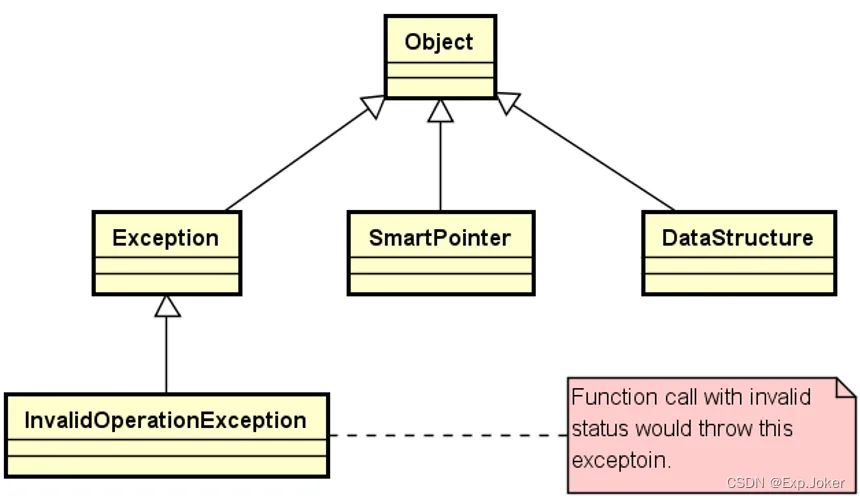
2、改进的关键点
- Exception类继承自Object类
- 堆空间中创建异常对象失败时,返回NULL指针
- 新增InvalidOperationException异常类
- 成员函数调用时,如果状态不正确则抛出异常
- SmartPointer 类继承自Object类
- 堆空间中创建智能指针对象失败时,返回NULL指针
3、编程实验:类族结构的进化
Exception.cpp
Exception.h
与上一个相同
4、DTLib 的开发方式和注意事项
- 迭代开发
- 每次完成一个小的目标,持续开发,最终打造可复用类库
- 单—继承树
- 所有类都继承自Object,规范堆对象创建时的行为
- 只抛异常,不处理异常
- 使用THROW_EXCEPTION抛出异常,提高可移植性
- 弱耦合性
- 尽量不使用标准库中的类和函数,提高可移植性
5、第一阶段学习总结
- 数据结构与算法之间的关系
- 算法效率的度量方法
- DTLib的基础设施构建
- 顶层父类
- 智能指针
- 异常类